Childish Sophistication
A reflection of my "career"


initium
I’ve had the unfortunate privilege of being born into a family of geniuses. My mother, father, and brother all possess cerebral prowess I feel ashamed to dream of. I am the ‘sore thumb’ that is constantly spoken of in legend—plastic cutlery among stainless steel forks and knives.
What do I do for work? In my eyes, absolutely nothing.
My first coherent memory is admittedly one blinded by nostalgia. In this image, I’m holding a Nintendo Gamecube controller, shoulder to shoulder with my brother, playing Mario Kart: Double Dash!! in a Cairo living room. We’re enshrouded in the darkness, with only Mario’s voice and world present to light up the room. It’s an image that, perhaps, has evolved to become romanticized. Nevertheless, it was my introduction to fictional worlds.
An identity had been formed. Though at the young age of 5, said identity was merely the world of Nintendo. It was frankly more of an obsession than an identity.
From that seedling of a personality, however, a strong desire to create worlds was born.
Just a few years later, I found myself obsessed with amateur fiction writing. Up until around the age of 11, I became obsessed with writing pseudo novels and short stories. They were barely tangible and had storylines of monotonous fever dreams, but that was irrelevant. They possessed such vibrant life through my own lens. My parents would brag to their friends, claiming me as some sort of extraordinary offspring; their pre-pubescent prodigy.
“Are you left-handed?,” one of my mother’s friends asked me, to which I replied, “I don’t think so.”
“Oh,” she said. “Usually lefties are more creative.”
I don’t remember exactly how I responded. Although it may sound silly, this was the first instance of self-doubt that I remember clearly.
I halted all my creative endeavors shortly after. With that, my identity as a creator of worlds vanished. What emerged was a version of myself that I loathed.
aequidistans
Everybody around me had started forming passions, from football to fashion and contemporary music, all of which I had minimal interest in. My only true passion was, still, the world of Nintendo.
Luckily, I was never tormented for my love of seemingly childish art forms. On the contrary, I felt I was embraced and respected for the unique approach I took in my recreational life. Soon, I was also able to lift the stigma I had placed on myself for continuing to fall in love with fictional worlds.
Academically, however, I was the embodiment of mediocrity. My parents, essentially scholastic savants, never seemed bothered by my lack of interest in school. I was too nescient to show gratitude at the time, but as years pass, I like to think I understand why they never did.
When I was approaching the end of middle school, my father took me to the university center of The New School in Manhattan’s 13th Street and 5th Avenue. He was born and raised in Egypt, but as a graduate of Fordham University, had a profound love for the city of New York.
“This is the school I want you to go to,” he told me.
The New School isn’t very selective, so at the cost of sentimentality, I must admit I think he chose this university as a realistic window into my future. Even still, it is an art school in his favorite city in the world.
With that memory in mind, I hope I understand now that my parents wished for me to become a creator of worlds.
pessimus
Although I now believe I understand my father’s intentions, my entering high school marked the beginning of a pragmatic outlook on life. What I desperately wanted to call pragmatism, however, was undoubtedly pessimism.
In light of this newfound interpretation of life, I managed to very easily convince myself that I could never make a living writing creatively, despite how badly I wanted to call myself a writer. Although it was formerly a passion of mine, I found it incredibly difficult to respect myself even thinking of that path, perhaps because of Egypt’s ritualistic society and culture. While my friends were all excelling academically, discussing paths of engineering and business, I would have nightmares of life unemployed, confined to an eternity of watching Cheers and Frasier over and over again, debating with myself which show I prefer.
To the surprise of many, I managed to graduate from high school. To the surprise of no one, my academic insecurities carried over to my life in university.
I did end up going to The New School. Not for creative writing, but to study journalism.
ad aetatem
Now, I could very well say that my adolescent devotion to creating worlds matured into a desire to use that very same medium to enlighten the masses. Perhaps, as an Egyptian and Lebanese man growing up in the Middle East, in the midst of political turmoil, I found inspiration to tell the objective story. Put simply, that would be a lie. I chose journalism believing my love of writing could justify what seemed like the only plausible career path for me, but I wasn’t interested in it at all.
I wish I had fascinating university stories to tell. Being 18 in New York City is really not as fun as one would think. The opposite is true, actually. It’s horrifying.
It’s nearly impossible to be physically alone in New York. Despite this (rather, because of this), it’s a breeding ground for loneliness.
I had an incredibly difficult time making friends, constantly feeling like a fish out of water in art school. Again, I can lie to myself and say this was because I grew up overseas to claim a clash of values. The truth is, I’ve just never been very good at socializing. My classmates were all incredibly comfortable expressing themselves, and frankly, it made me extremely uncomfortable. I’ve never opened up to anyone I haven’t known for longer than 10 years (besides a therapist), and everybody around me was doing so with their professors, acquaintances, and even the cafeteria workers. It was bizarre to me and shook my definition of friendship.
dolor
In my third year of college, I experienced my first anxiety attack. I can’t say exactly what caused it, but I can confidently say that my feeble social life was complicit in some way. It was an apocalyptic experience, and in the following months, I allowed myself to be completely submerged in solitude. I was living alone in a studio apartment on 14th Street and 9th Avenue, and with minimal companionship, it’s not hard to imagine how I became synonymous with anxiety.
My mental health misfortunes manifested themselves in the form of hypochondria, also known as health anxiety. In short, I lived life on a perpetual deathbed. A headache is a brain tumor, a twitch is a seizure, and a panic attack is insanity. The mental symptoms it causes lead to a diverse array of physical symptoms, which fuel the condition like drugs to depression. As an instigator of madness, it does its job quite well.
I developed a fear of sleep, as I truly believed the angel of death worked the hours of midnight to six in the morning. It didn’t take long before I could barely recognize myself, and spent hours in the bathroom with my index and middle fingers glued to my jugular, desperately trying to retain my identity through the shedding of tears.
sileo
One day, after class, a professor of mine told me to stay after everyone had left.
“I’ve never seen anyone so discernibly suffering,” she told me. It certainly was naive of me to believe that I could keep my agony bottled up, as she had immediately recommended me to the school’s therapy program.
I had to wait around two weeks for my first session, so I returned home to Egypt for a short sabbatical as my life had been degraded to a struggle for stability.
As soon I touched down at Cairo Airport, I felt as though I had accepted defeat. And like any man defeated, I stood on a paper-thin line between inadequacy and admirability. Returning to my childhood bedroom as a vessel of ruin was a surreal experience, comparable to a simultaneous sense of pity and grief.
A good family friend of ours is a well-known psychiatrist in Cairo, so I was lucky enough to get a head start on some necessary psychoanalysis before returning to New York to continue classes and therapy.
With the support of my mother, and what I love to call good fortune so as to not fall once again in the darkness, I was able to begin managing my anxiety.
resolvere
It took a while before I truly understood that there is no such thing as a cure for anxiety disorders, which led to many nights of frustration and hopelessness. It eventually became my ticket to peace, however, as I embraced my life with the imaginary illness. I may always quiver at the sensation of a headache, or a cough that lasts longer than five minutes, but with that, I managed to adopt a new identity. And so, upon returning to my mirror, I was able to keep my fingers away from my throat and shed tears of new meaning.
I suppose “new meaning” is slightly inaccurate; I should probably say “returning meaning.” The previous two years had been spent in journalism courses, devoid of creativity and motivation. But through my newfound misery, not only did my desire to create worlds resurface, but the belief in myself to do so did as well.
I actually told myself that I could be a novelist, and somehow, believed it. One year later, I began work on my first novel: The Hypochondriac of 9th Avenue. Although it is still a work in progress, I never feel more alive than when I am creating this world.
College is known as the time for one to find oneself. I never appreciated this saying, as “find” is contextually ambiguous and often used as an excuse for careless behavior. I previously understood it on a very stereotypical level, perhaps through identity experimentation or drug abuse. It’s self-confrontation, however, that has been at the root of this concept all along. The use of drugs can certainly lead someone to dive into necessary self-reflection, but I never truly understood what “finding yourself” meant until I lost sight of myself.
opus
I graduated around two years ago. Since then, I have acquired what can just barely pass as a career.
I struggled to find a job relating to my field of study immediately after graduation, so I picked up a customer service job at a furniture store until I stumbled upon good fortune.
A few months later, I was able to find work as a reporter at an online newspaper. I tried doing both jobs at the same time to alleviate the financial burden of living in New York but was immediately fired from the furniture store due to an almost instant drop in productivity.
My work as a reporter was incredibly mundane. It consisted of writing three to five articles per day on topics that needed to generate traffic, or clicks. In other words, it didn’t test my journalistic abilities, but rather how well I could write sensationalist headlines. I immediately started looking for other jobs, as it somehow paid less than the customer service job and made me question the journalism industry.
After months of seemingly empty job applications, I was somehow met with two job offers: another position as a reporter at Reorg, a data and intelligence provider for investment banks and other financial institutions. And a job at LinkedIn, as an editorial content coordinator.
The position at Reorg was a full-time role, while the position at LinkedIn was a three-month contract with a chance for an extension. I spent no more than an hour with a slight headache deciding which of these two vacancies was the right choice for me.
I and two other contractors started working at LinkedIn to help launch a spin-off of their “Top Companies” lists, where in-house data is used to to rank corporations based on how well they can advance one’s career. By the end of the three-month contract, one of us was to be selected for a year-long extension. Luckily, I was chosen.
I started out my contract extension with a primal impulse to thrive, as part of me hoped I could be a part of this team full-time. They had even extended my contract a second time. But as time went on and I understood that I was on a dying metronome, my motivation faded. I began screwing up even the simplest of tasks, and if it wasn’t for the incredible patience of my coworkers and superiors, I would have been unemployed much sooner.
At the time of writing this, my time at the company will have officially ended, beginning a new era of unemployment. All I have to my name are dozens of job applications that have fallen upon deaf ears, and a novel that’s been in limbo for almost two years.
I’m lost. Moreover, the hardheaded high schooler within me is worried once again that a steady income is nothing but a fantasy.
audacia
I wrote earlier that I never really had an interest in journalism as a career path.
Journalism is an extraordinarily powerful means of communication. It doesn’t only shape perspective, it shapes truth. In Egypt, most news publications are owned by the government, so I was under the impression that the West produced neutral journalism; an embodiment of the United States’ alleged respect for democracy.
I was wrong.
Western media is just as experienced in obscuring information. Each outlet’s content is carefully crafted to appease certain vantage points, intended to fuel polarity and make an oxymoron out of these so-called “United” States of America.
I don’t expect anyone to raise a glass to such ordinary observations. This isn’t some sort of nuanced revelation; it’s essentially common knowledge, and why independent news outlets are gaining momentum.
Left or right, progressive or conservative; such identity points are merely props in a play that give storylines momentum. It’s far too effortless to highlight the differences we have as a collective people, so that’s exactly what media corporations do: manipulate emotions for capital gain. If we took just a little time to find common ground, the societal results could be transformative.
It all becomes more clear if we just take a closer look at emotion, and its amenable nature. A beautiful sensation that, when used appropriately, can humanize the seemingly inhumane. Be that as it may, it can just as easily be complicit in mass acts of dehumanization with calculated vile intentions.
That’s where I believe the journalism industry currently stands: a desperate search for subjectivity within objectivity.
It feels childish of me to make such ill-tempered declarations and not provide cases in point. Simply put, it doesn’t feel appropriate in the context of what is essentially a self-reflection. I do plan to dig much deeper into these claims and provide possible solutions in a future piece.
principium
A close friend recently sent me the following quote from Friedrich Nietzsche:
“Beware that, when fighting monsters, you yourself do not become a monster... for when you gaze long into the abyss, the abyss gazes also into you.”
Truthfully, I didn’t know how to initially interpret it.
“Those who engage in a struggle against oppression or forces of evil in general must be careful not to become consumed by their anger and frustration,” my friend shared his decoding with me. “If they do, they risk becoming the very thing they are fighting against.”
I added to his point, stating that the more emotional one is in response to an event, the more credibility is lost.
He agreed but made sure to clarify something.
“Frustration and anger are engines for change. Channeling that rage into something tangible is a powerful life skill.”
As beautifully put as that is, I am not skilled enough to do so at the moment. While there’s plenty of life to antagonize, it’s a privilege to be able to do so within the confines of justice. I will strive to reach a point in my life where I can be impartially angry.
vita
If someone were to ask me what I consider paradise, I’d respond with the following memory I have.
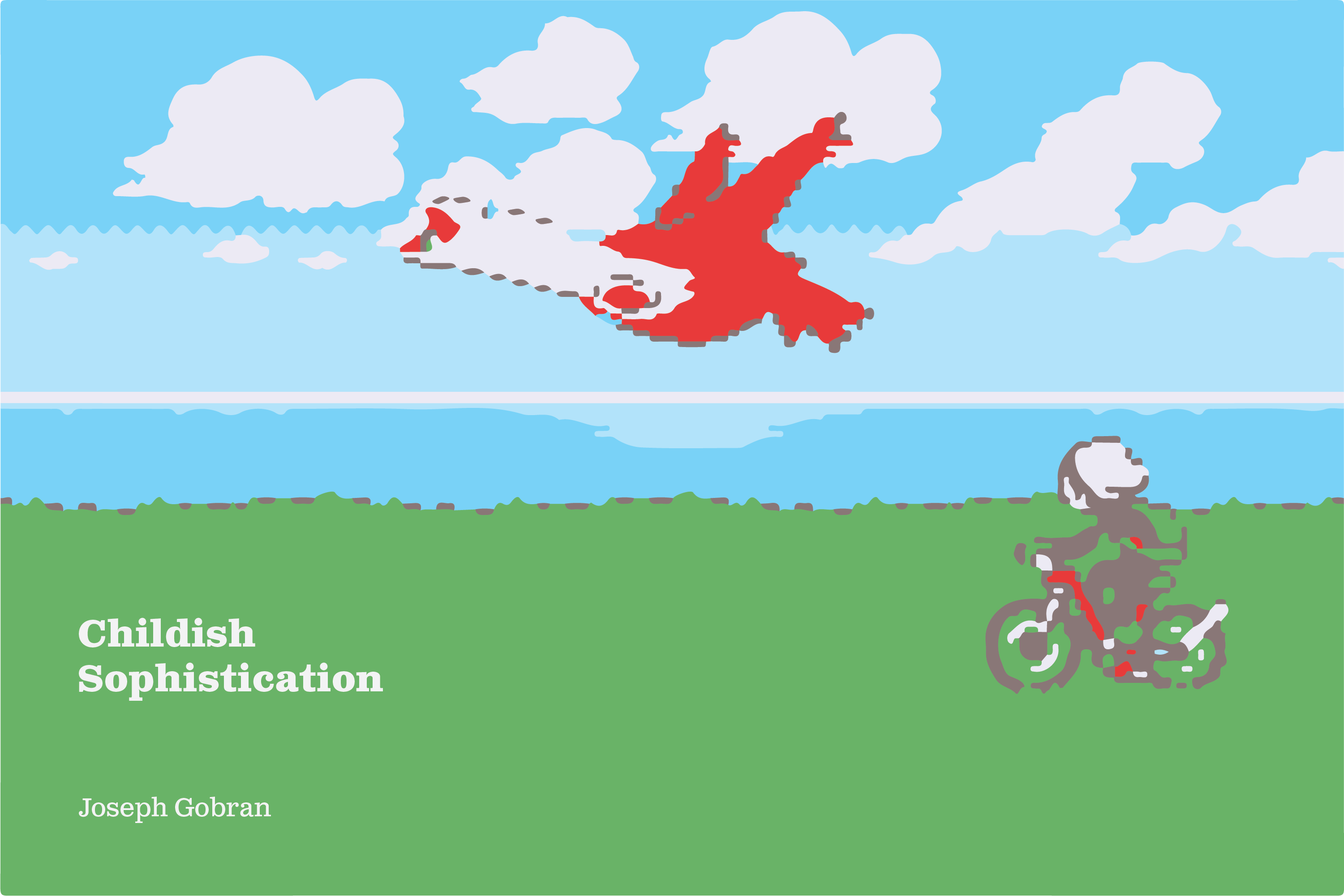
Tears of water fall from leaves into a spring, creating graceful ripple effects. Just as I’m being hypnotized by nature’s parental embrace, the silhouette of a sleek dragon soars above me. I rush to my bicycle in an attempt to catch up with the beast and begin desperately pedaling as if it were chasing me. The maternal blue sky and ocean are accomplices in my pursuit of this legendary monster; the lustrous green grass is my bedrock. My legs begin to bow out, however. There’s no way my athletic abilities can match the supernatural potential of this mystery.
Suddenly, as if it senses my self-doubt, it flies ahead from behind. Was I outpacing it this whole time?
It’s gliding next to me. Its physique is angelic; red like the blood moon and smooth like minimalistic technology. I’ve stiffened my neck gazing at this thing, completely indifferent to any hazards that may be in my path. Finally, it bolts past as if asking me to give chase. Of course, I accept its invitation.
Needless to say, this didn’t actually happen. For those who are unaware, this is the introduction sequence for Pokémon: Sapphire Version (my pretentious, hyperbolic interpretation of it.)
As I currently suffer from the disease of disorientation, I find myself returning to this image quite frequently. It’s a reminder of my primitive desire to create worlds, and what I like to call childish sophistication. In short, it gives me life.
Journalism makes me feel like a constant accomplice to shaping an out-of-context perspective. It’s important to note that, when I criticize journalism, I do so only on an industrial level.
At the root of journalism is nobility; it does not function properly when it is reduced to an enterprise. It is most effective as a public service, when conflicting interests aren’t at play, and the pursuit of objective reality is the sole priority.
Who am I to make such bold claims, however? An unemployed hypochondriac, sometimes afraid of a mere gaze into the mirror. Unworthy of the title ‘failed artist’. Still obsessed with the world of Nintendo, in desperate need of a mid-life crisis. Plastic cutlery in a sea of stainless steel forks and knives.
“I’ve always dreamed of being a writer. Or, at the very least, feeling worthy of calling myself one. In my head, I’m an award-winning author with revolutionary ideas, but when pen meets paper I’m a miserable fool.”
-Joseph Gobran, The Hypochondriac of 9th Avenue